


What Are the Types of Spray Dryers? Detailed Explanation of Working Principles and Applicable Scenarios
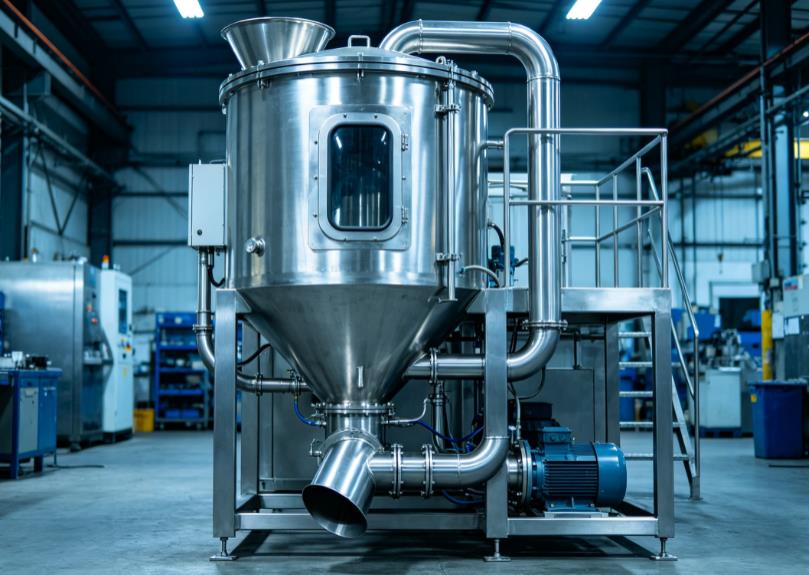
Spray dryers are classified into four main types based on atomization methods: pressure type, centrifugal type, pneumatic type, and closed-loop type, each with distinct working principles and applicable scenarios.
📅 Timeliness Note:This article was published on June 4, 2026. Some information may have been updated. It is recommended to make comprehensive judgments based on the latest industry trends.
In the field of industrial drying, spray dryers have become core equipment in industries such as food, pharmaceuticals, chemicals, ceramics, and new energy, thanks to their advantage of one-step forming from liquid to powder. Whether it is instant milk powder, antibiotic powder, or lithium battery cathode materials, their production relies on the precise control of spray dryers. However, faced with a wide variety of models on the market, many practitioners often find themselves confused when selecting the right type: Should they choose a pressure nozzle or a centrifugal type? What working conditions are suitable for a pneumatic type? Below, starting from the most core atomization method, we will systematically outline the four major classifications, analyze their working principles and applicable scenarios, and provide professional reference for your equipment selection.
I. Pressure Nozzle Spray Dryer
Working principle:The pressure nozzle spray dryer uses a high-pressure pump to pressurize the feed liquid to 2–20 MPa and sprays it through a specially designed nozzle (such as a swirl nozzle or single-hole nozzle). Under high pressure, the feed liquid rotates at high speed and, upon exiting the nozzle orifice, instantly disperses into fine mist-like droplets. After the droplets come into contact with hot air, the moisture rapidly evaporates, forming hollow spherical or granular products. Its atomization effect depends on the nozzle structure, operating pressure, and feed liquid viscosity.
Applicable Scenarios:
- High Particle Requirements:Suitable for materials requiring larger particle sizes (typically 50–300 μm), regular spherical shapes, or hollow particles, such as instant milk powder, coffee creamer, and ceramic microspheres.
- High-Viscosity Feed Liquids:Wide adaptability to viscosity ranges (up to 300–500 mPa·s), but attention should be paid to the risk of nozzle clogging.
- Heat-Sensitive Materials:Due to the extremely short contact time (milliseconds) between the feed liquid at the nozzle and the hot air, it is particularly suitable for drying heat-sensitive materials such as enzyme preparations and vitamins.
- Production Capacity:Suitable for small to medium-sized production lines, with a single unit's water evaporation capacity reaching hundreds to thousands of kilograms per hour.
II. Centrifugal Spray Dryer
Working principle:The core component of the centrifugal spray dryer (also known as the rotary type) is a high-speed rotating atomizer (centrifugal disc), typically operating at speeds of 10,000–30,000 rpm. The feed liquid is introduced into the center of the high-speed rotating centrifugal disc, where it is thrown toward the disc edge under centrifugal force and torn into fine mist-like droplets. The droplet size distribution is determined by the centrifugal disc structure, rotational speed, and feed liquid flow rate. Hot air generally enters from the top of the drying tower tangentially, forming a co-current contact with the droplets.
Applicable Scenarios:
- High Production Demand:The centrifugal spray dryer is currently the model with the largest production capacity in industrial applications, with a single tower's water evaporation capacity exceeding 10 tons per hour, suitable for large-scale production such as starch, chemical intermediates, and dyes.
- Low-Viscosity Feed Liquids:Requires relatively low feed liquid viscosity (generally below 300 mPa·s), suitable for suspensions, emulsions, and solutions, such as pigments and detergents.
- No Particle Requirements:Due to the fine droplet size (20–100 μm), the product is mostly fine powder, suitable for scenarios where particle size is not critical.
- Heat-Sensitive and Easily Oxidized Materials:The co-current design ensures low-temperature contact with wet materials, and the closed system can introduce inert gas, suitable for food (e.g., egg powder, milk powder) and pharmaceuticals (e.g., traditional Chinese medicine extracts).
- Maintenance Characteristics:No risk of nozzle clogging, but the high-speed centrifugal disc requires regular maintenance of bearings and seals.
III. Pneumatic Spray Dryer
Working principle:The pneumatic spray dryer uses compressed air (or steam) as the atomization medium. The feed liquid and high-speed gas stream (velocity can exceed 300 m/s) mix inside the nozzle chamber, where the gas tears the liquid into droplets through shear forces. Based on the mixing method, it can be divided into internal mixing, external mixing, and internal-external mixing. This method does not require a high-pressure pump but needs a compressed air system, resulting in higher energy consumption.
Applicable Scenarios:
- Extremely Small Particle Requirements:The pneumatic type can produce the finest droplets (typically <10 μm), suitable for ultrafine powder production, such as nanomaterials, microencapsulated drugs, and catalysts.
- High-Viscosity or Non-Newtonian Fluids:Good tolerance to feed liquid viscosity (can handle pastes of thousands of mPa·s), suitable for viscous materials such as dextrin and resins.
- Small Batch, Multiple Varieties:Small equipment size, easy to disassemble and clean, suitable for laboratory R&D or small-scale production, such as fragrances and cosmetic intermediates.
- Extremely Heat-Sensitive Materials:Due to the extremely fine droplets after atomization, the drying time is very short (even fractions of a second), with low evaporation temperature, suitable for heat-sensitive biological products.
- Note:Energy consumption per unit product is relatively high (typically 2–3 times that of pressure nozzle or centrifugal types), not suitable for large-scale low-cost production.
IV. Special Type: Closed-Loop Spray Dryer
Working principle:The closed-loop spray dryer is based on the three atomization methods above, with the drying system designed as a closed circuit. The drying medium (typically nitrogen) is circulated within the system, and organic solvents in the material are condensed and recovered, avoiding contact with air. The atomization method can be selected as pressure nozzle, centrifugal, or pneumatic based on requirements.
Applicable Scenarios:
- Organic Solvent Materials:Such as pharmaceutical intermediates, catalysts, and lithium battery materials (e.g., NMP solvent systems), requiring solvent recovery and explosion prevention.
- Easily Oxidized or Hygroscopic Materials:Such as vitamin C and certain pharmaceuticals, requiring drying in an oxygen-free or low-humidity environment.
- Toxic or Hazardous Materials:To prevent the emission of harmful substances into the atmosphere.
Summary: Core Selection Strategy
When facing specific working conditions, it is recommended that practitioners consider three dimensions comprehensively:Material Properties(viscosity, heat sensitivity, whether containing solvents),Product Requirements(particle size, particle morphology, bulk density),Production Capacity and Cost(Investment, Energy Consumption, Maintenance). The following is a quick selection logic:
- If pursuing large particles, regular spherical shape, and moderate production capacity → Pressure Type
- If pursuing ultra-large scale, fine powder, and low-viscosity feed liquid → Centrifugal Type
- If requiring ultra-fine powder, handling high viscosity, or small batches → Airflow Type
- If involving organic solvents or requiring inert protection → Closed-Cycle System(Combined with a suitable atomizer)
It is worth mentioning that in recent years, technologies such as multi-channel nozzles, ultrasonic atomization, and dual-fluid high-pressure systems have been continuously integrated. Spray dryers are evolving toward greater energy efficiency, higher precision, and increased intelligence. Only by mastering the underlying logic of various equipment can one excel in this precision engineering of “atomization—drying—powder formation.”
FAQ
What are the main types of spray dryers?
Spray dryers are classified into four main types based on atomization methods: pressure type, centrifugal type, pneumatic type, and closed-loop type, each with distinct working principles and applicable scenarios.
What materials are suitable for pressure spray dryers?
The pressure-type method is suitable for high-viscosity or heat-sensitive materials that require large, uniformly spherical particles, such as instant milk powder and enzyme preparations, with medium production capacity.
What is the working principle of a centrifugal spray dryer?
Centrifugal atomization uses a high-speed rotating centrifugal disc (10,000–30,000 rpm) to disperse the feed liquid into a fine mist, which is then dried in co-current contact with hot air. This method is suitable for large-capacity, low-viscosity feed liquids.
What applications are suitable for airflow spray dryers?
The pneumatic type is suitable for ultra-fine powders (<10μm), high-viscosity or small-batch materials, such as nanomaterials and microencapsulated pharmaceuticals, but its energy consumption is relatively high.
What are the characteristics of a closed-loop spray dryer?
The closed-loop system uses inert media such as nitrogen for sealed circulation, making it suitable for drying and solvent recovery of materials containing organic solvents, easily oxidized substances, or toxic components.