


Working principle of spray granulation dryer
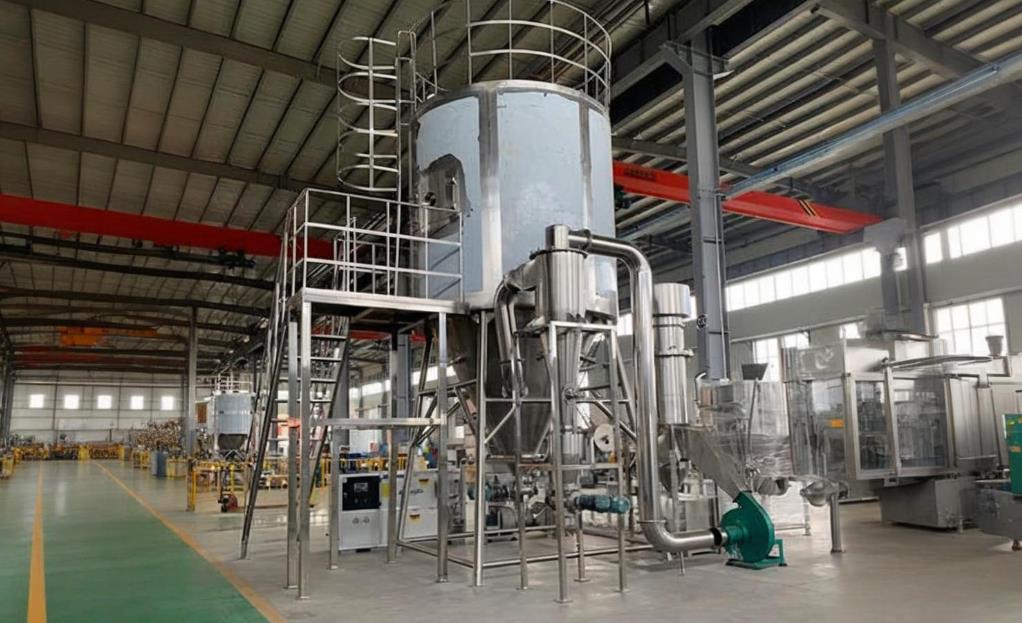
The spray granulation dryer atomizes liquid materials and brings them into contact with hot air, instantly evaporating moisture while the droplets agglomerate and form into spherical particles, thereby integrating drying and granulation in a single process.
📅 Timeliness Note:This article was published on August 21, 2026, and some information may have been updated. It is recommended to make a comprehensive judgment in light of the latest industry developments.
I. Basic Equipment Structure and System Composition
Spray granu
A spray granulation dryer is a piece of process equipment that directly dries liquid materials while simultaneously completing granulation, enabling materials in forms such as solutions, emulsions, and suspensions to be converted into spherical granular products with a specific particle size in a single treatment. Compared with ordinary spray dryers, a spray granulation dryer not only accomplishes moisture evaporation but also simultaneously achieves particle formation and agglomeration. Therefore, the product form is predominantly granular rather than powdery. This integrated “drying + granulation” characteristic determines that its working principle differs significantly from conventional spray drying in multiple aspects.
I. Basic Equipment Structure and System Composition
- A spray granulation dryer is a complete set of equipment in which multiple subsystems operate in coordination. A typical pressure-type spray granulation dryer mainly consists of five major parts: the feed system, drying system, heating system, dust collection system, and electrical control system.
- The feed system includes mixing tanks, filters, diaphragm pumps, and spray guns (nozzles). The slurry, after ball milling or formulation, is transferred from the upstream process to the mixing tank, passes through the filter to remove impurities, and is then pressurized by the diaphragm pump and delivered to the spray gun before entering the drying tower.
- The core of the drying system is the spray granulation tower (drying tower), which also includes a supply fan, hot air distributor, and exhaust fan. The heating system provides hot air for the drying tower and can adopt various forms such as electric heating, steam heating, coal-fired hot air furnaces, or oil (gas)-fired hot air furnaces. The dust collection system typically consists of high-efficiency cyclones, bag filters, and centrifugal fans. The electrical control system monitors and controls each operating stage of the equipment through field instruments such as temperature sensors installed at the air inlet and material outlet.
- The drying tower body is typically made of stainless steel (e.g., SUS304), with an insulation layer provided between the inner body and the outer shell. The tower body is also equipped with observation doors, sight glasses, light sources, and control instruments to facilitate observation of the operating conditions inside the tower during operation.
II. Essential Differences Between Spray Granulation and Ordinary Spray Drying
Before discussing the working principle in depth, it is necessary to clarify the differences between spray granulation drying and ordinary spray drying.
- The core function of ordinary spray drying is dehydration: liquid materials are atomized and brought into contact with hot air, where moisture evaporates rapidly, yielding a dry powdery product. The residence time is typically only a few seconds.
- Spray granulation drying is different. While completing moisture evaporation, it also utilizes inter-droplet agglomeration and adhesion effects to grow particles, forming spherical granules with a specific particle size. Due to the need to complete particle growth and solidification, the residence time of the material in the tower is longer, generally 10 to 30 seconds. Correspondingly, the energy consumption of granulation drying is approximately 10% to 25% higher than that of ordinary spray drying. However, granular products exhibit better flowability, anti-caking properties, and solubility, facilitating subsequent tableting, coating, packaging, and transportation.
- From the perspective of product form, the products of ordinary spray drying are mostly powdery, with particle diameters typically ranging from 0 to 50 micrometers; whereas the products of spray granulation drying are granular, with generally larger particle sizes.
III. Core Working Stages
The complete process of spray granulation drying can be divided into three core stages: slurry atomization, droplet drying and ball formation, and granular powder discharge.
(1) Slurry Atomization
- The slurry is pressed into the drying tower from the nozzle by the diaphragm pump in the feed system at a certain pressure. The energy of the pressure is converted into kinetic energy during this process. After being ejected from the nozzle, the slurry forms a high-speed moving liquid film, which immediately splits into fine droplets.
- The atomization effect directly determines the particle size and quality of the final product. In a pressure-type spray granulation dryer, the spray pressure is generally controlled within the range of 20 to 30 bar. The droplet size produced by atomization is inversely proportional to the spray pressure—the higher the pressure, the finer the droplets; while the production capacity of the nozzle is proportional to the square of the pressure. Operators can control the desired particle size by adjusting the liquid feed rate, nozzle orifice diameter, and slurry concentration.
- The structural design of the nozzle has a significant influence on the atomization effect. After entering the nozzle, the feed liquid passes through the tangential grooves of the swirl plate and rotates into the swirl chamber, forming atomization at a certain angle through the high-hardness nozzle core. The spray angle is related to the pressure level and the thickness of the swirl plate: the thicker the swirl plate, the smaller the spray angle; conversely, the thinner the plate, the larger the angle. Generally, the spray angle ranges from 45 to 90 degrees at the outlet. The selection of nozzle orifice diameter also needs to be adjusted according to material characteristics. For example, a Model 25 unit typically uses an orifice diameter of 0.5 to 0.8 mm, while a Model 50 unit uses an orifice diameter of 0.7 to 1.0 mm.
(2) Droplet Drying and Ball Formation
- After entering the drying tower, the atomized droplets come into contact with hot air and enter the drying and ball-formation stage.
- The hot air is heated by the heater and enters the tower through the hot air distributor at the top of the drying tower. The hot air distributor generates a downward streamlined air flow. It is worth noting that in pressure-type spray granulation drying, the droplets are typically sprayed upward from the bottom into the hot air stream, forming a mixed-flow contact pattern—which differs from the co-current flow commonly used in ordinary spray drying.
- After entering the hot air stream, the droplets naturally contract into spherical shapes due to surface tension. At the same time, the droplets have an extremely large specific surface area, and moisture evaporates rapidly at high temperatures. This drying process is extremely fast—after atomization, the surface area of the feed liquid increases dramatically, and 95% to 98% of the moisture can be evaporated instantaneously in the hot air stream, with the complete drying time requiring only ten-plus seconds to several tens of seconds.
- As moisture continues to evaporate, the droplets gradually shrink and solidify, ultimately forming dry spherical particles. The particles gradually settle in the drying tower by gravity, achieving preliminary separation from the hot air. The funnel-shaped chamber at the lower part of the tower collects the granular material and discharges it from the outlet. Finer particles are carried along with the drying air and drawn by the exhaust fan into the dust collection system.
(3) Granular Powder Discharge and Gas-Solid Separation
- The dust collection system consists of high-efficiency cyclones, bag filters, and centrifugal fans. The exhaust fan delivers the finer particles together with the drying air into the high-efficiency cyclone separator. After cyclone separation, the finer particles settle into the collection bin at the bottom of the separator for recovery. The exhaust gas containing very small amounts of fine particles subsequently enters the bag filter for secondary dust collection, achieving harmless treatment of the exhaust gas before it is finally discharged from the chimney.
- The total recovery rate of the entire system can reach 96% to 98%. A secondary dust collection device can also be installed at the fan outlet to further improve the recovery rate.
IV. Key Process Parameters and Their Effects
The operating performance of spray granulation drying is jointly influenced by multiple process parameters, and operators need to make comprehensive adjustments based on material characteristics and product requirements.
- Spray pressure is the core parameter for controlling particle size. The higher the pressure, the finer the droplets and the smaller the finished particles; the lower the pressure, the larger the droplets and the larger the particles. Generally, the spray pressure is controlled within the range of 20 to 30 bar.
- Inlet temperature affects the drying rate and product quality. Excessively high temperatures may cause degradation of active ingredients in heat-sensitive materials; excessively low temperatures result in insufficient drying and higher moisture content in the product. For heat-sensitive materials, the inlet temperature must be strictly controlled.
- The solids content of the feed liquid is also an important variable. Spray granulation dryers are typically suitable for spray granulation of feed liquids with a solids content of 40% to 70%. A high solids content facilitates the formation of solid particles and improves the bulk density of the granules.
- The nozzle orifice diameter and swirl plate thickness determine the spray angle and atomization effect, and appropriate specifications need to be selected according to the characteristics of different materials.
V. Application Fields
Due to its unique integrated “drying + granulation” function, the spray granulation dryer has been widely applied in multiple industries.
- In the pharmaceutical industry, this equipment is used to prepare granules for tablets, instant granules, and capsules, as well as low-sugar and sugar-free traditional Chinese medicine granules. It can also replace traditional oscillating granulators to achieve integrated low-temperature spray drying and coating production.
- In the food industry, the spray granulation dryer is suitable for granulating materials such as cocoa, coffee, milk powder, granular fruit juice, and seasonings. For materials such as collagen peptide instant granules and food additives, dynamic adjustment of water pressure through electrical control can effectively prevent caking.
- In the chemical and other industries, this equipment is widely used for granule preparation in fields such as pesticides, feed, fertilizers, pigments, and dyes. In addition, granulation of ceramic powders, alumina, cemented carbide, and other materials is also an important application direction.
FAQ
What is the working principle of a spray granulation dryer?
The spray granulation dryer atomizes liquid materials and brings them into contact with hot air, instantly evaporating moisture while the droplets agglomerate and form into spherical particles, thereby integrating drying and granulation in a single process.
What is the difference between a spray granulation dryer and a conventional spray dryer?
Ordinary spray drying only dehydrates the material into powder, whereas spray granulation drying, while evaporating moisture, simultaneously grows the particles into spherical shapes, resulting in a granular product with a longer residence time and higher energy consumption.
What are the core working stages of a spray granulation dryer?
The core stages of a spray granulation dryer include slurry atomization, droplet drying into spheres, and discharge of granular powder; throughout the process, pressure atomization forms droplets, and hot air drying solidifies the particles.
Which parameters affect the particle size of spray granulation dryer granules?
Spray pressure, inlet temperature, feed solid content, nozzle orifice diameter, and vortex insert thickness affect particle size. Higher pressure results in smaller particles, while high solid content tends to form solid particles.
What industry applications is the spray granulation dryer suitable for?
Spray granulation dryers are widely used in industries such as pharmaceuticals, food, and chemicals for the production of spherical granular products, including tablet granules, instant coffee, milk powder, pesticides, and ceramic powders.