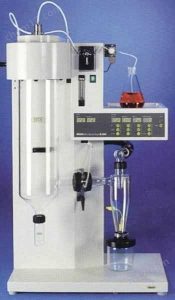
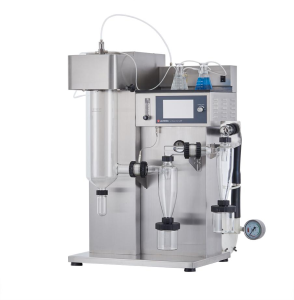
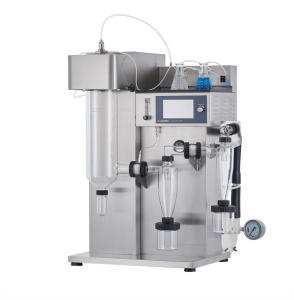
Direct answer:The H-Spray Mini compact spray dryer is a compact spray drying system specifically designed for laboratory R&D, pilot-scale scale-up, and small-batch production. This model integrates a modular design philosophy with precision process control, enabling efficient drying performance while minimizing sample residue and material loss. It is suitable for micronization processing of heat-sensitive and dispersible materials in the chemical, pharmaceutical, food, new materials, and biological products industries.
Its core working principle is as follows: liquid materials (solutions, emulsions, or suspensions) are delivered via a high-precision peristaltic pump to a two-fluid atomizing nozzle, where they are subjected to clean compressed air
The H-Spray Mini compact spray dryer is a compact spray drying system specifically designed for laboratory R&D, pilot-scale scale-up, and small-batch production. This model integrates a modular design philosophy with precision process control, enabling efficient drying performance while minimizing sample residue and material loss. It is suitable for micronization processing of heat-sensitive and dispersible materials in the chemical, pharmaceutical, food, new materials, and biological products industries.
Its core working principle is as follows: liquid materials (solutions, emulsions, or suspensions) are delivered via a high-precision peristaltic pump to a two-fluid atomizing nozzle, where uniform fine droplets are formed under the shear action of clean compressed air. These droplets come into instantaneous contact with hot air heated after passing through a high-efficiency filter inside the drying chamber, causing rapid solvent evaporation. Solid particles complete drying and formation within an extremely short period, and are ultimately collected by a cyclone separator as spherical, porous, or hollow-structured powder particles. The entire drying process is typically completed within seconds, making it particularly suitable for temperature-sensitive active substances.
- Miniaturized High-Efficiency Design:The entire unit occupies less than 0.5 square meters of floor space and can be operated within a standard fume hood, making it suitable for batch-wise process exploration of high-value-added materials.
- Precise Parameter Control:The inlet air temperature can reach up to 240°C, with real-time display of the outlet air temperature. PID regulation achieves temperature control accuracy of ±1°C, ensuring a high degree of experimental data reproducibility.
- High Recovery Rate and Low Residue:An anti-static polycarbonate collection bottle and a specially designed cyclone gas-path structure enable a minimum recovery quantity of 0.2 g, effectively meeting the drying requirements of expensive samples.
- Easy Cleaning:The drying chamber and cyclone separator are connected via quick-release clamp fittings that can be disassembled without tools, supporting online cleaning and high-temperature inactivation to prevent cross-contamination.
- Extended Adaptability:Optional modules include an inert gas circulation module (suitable for organic solvents), a refrigerated feed system (suitable for heat-labile biological products), and a fine particle collection device, enabling multi-purpose use of a single unit.
In practical application scenarios, the H-Spray Mini can efficiently produce microcapsules, solid dispersions, nano-agglomerates, and traditional Chinese medicine extract powders. Typical applications include probiotic encapsulation, protein drug powderization, ceramic precursor granulation, catalyst support forming, and flavor and fragrance powderization. This equipment provides purchasers with complete data support from laboratory process parameter exploration to pilot-scale scale-up validation, significantly shortening new product development cycles and reducing scale-up risks.
With its streamlined structural design, stable operational performance, and flexible upgrade options, the H-Spray Mini has become an ideal selection for global research institutions and pharmaceutical and chemical enterprises conducting spray drying process research. All product-contact components are manufactured from 316L stainless steel and medical-grade borosilicate glass, complying with FDA and GMP requirements, fully ensuring product safety and data compliance.





 Changzhou Thumb Drying Technology Co., Ltd.